
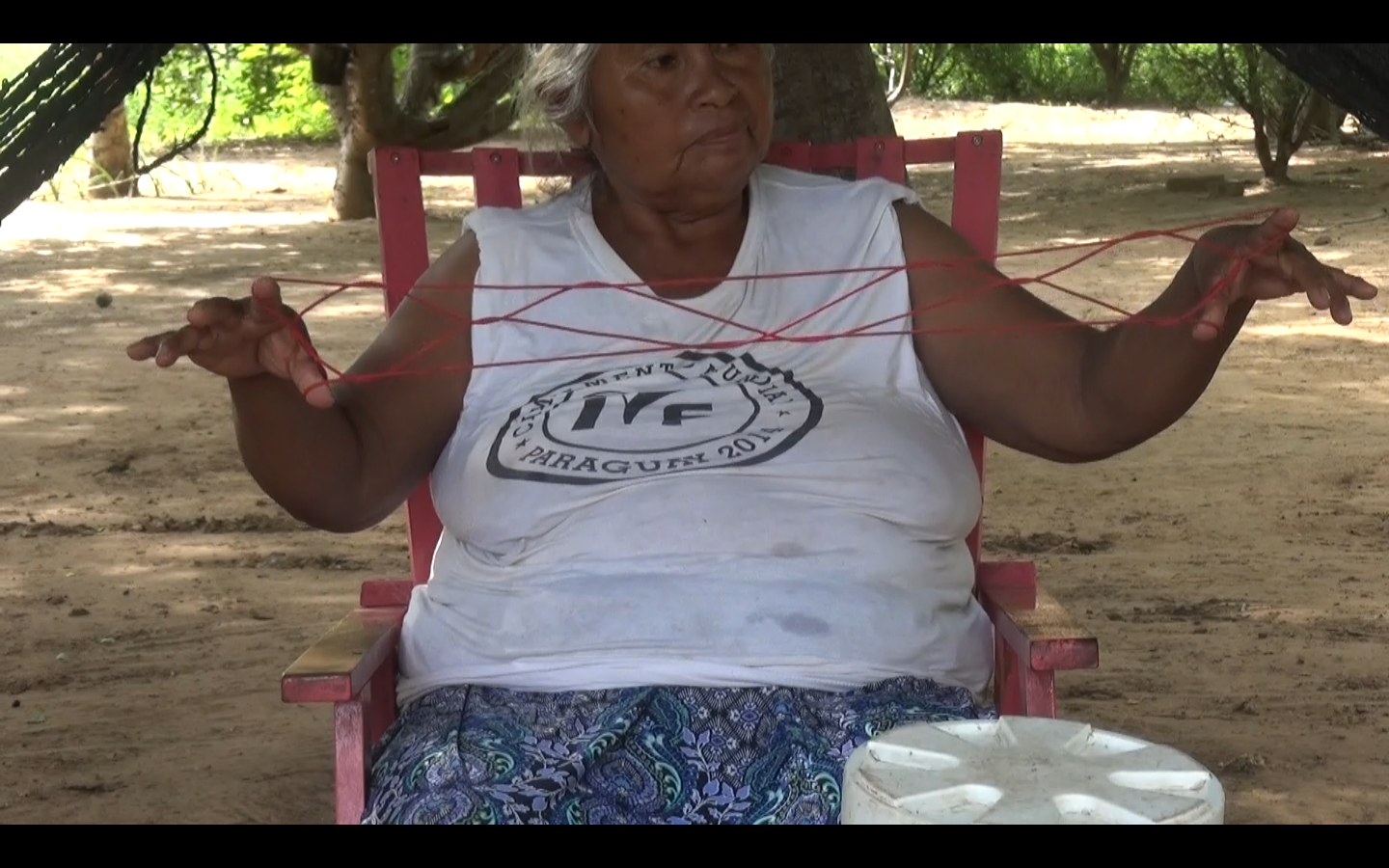
HEEYAMAC (1), doca fruits
Geolocation
Relations
Item Relations
| This Item | related through similar or identical final pattern (with a different construction): | Item: HEEYAMAC (2), doca fruits |
| Item: SAJIYÔ (2), doca fruits | String figure with similar final figure: | This Item |
Graphical representation of this item’s relations
Citation
- Overall presentation
-
Name : HEEYAMAC (1), doca fruits
-
Creator : David Jabin
-
Contributor(s) : Elsa de Unruh, village of Belen, Yalve Sanga , Central Chaco, Paraguay
-
Date : 2019-2020
- Information on the string figure
This string figure represents some fruits of the liana Morrenia variegata species, known in the Chaco region as doca, tasi or, in the regional guarani of the paraguayan Chaco, as guaycuru rembi'u.
The fruit of Morrenia species have alimentary and mythological importance.
The fruits are symbolized by the for diamond-shapes. The particular shape of the fruit is highlighted in some myths in which the fruit has to do with the creation of women at a time when only men existed (Arenas, 1981: 279-281).
The Morrenia spp. lianas odorata are a widespread plant of the South American Gran Chaco, where both indigenous and non-indigenous groups use it as a food for much of the year. The fruit is the plant part most commonly eaten and prepared in various ways: either raw, in salads, boiled, or roasted. The indigenous population considers it to be a very wholesome food and, despite the loss of many elements of their traditional diet, this plant continues to be highly valued. Although it is a wild plant, it is protected and even cultivated by several ethnic groups (Arenas, 1999).
HEEYAMAC (1) has another enlhet variant HEEYAMAC (2) with a diffrent construction method and a bit different final pattern, with different crossings but with a similar general look.
SAJIYÔ (1) and SAJIYÔ (2) are two nivacle figures with same meaning but SAJIYÔ have a very different construction method and final pattern.
2. Proximally, insert 1345 into 2 loops.
3. Transfer 2 loops to teh Wirsts.
4. Release 5. Extend.
5. Pass the mouth away from you into the little triangle made by Wn and 1n. With the Teeth, grasp the string 5f.
6. Distally, insert 5 into T loop and return to position. Release Teeth.
7. Release W loops. Extend.
8. Transfer 1 loops to 2. Extend.
9. Distally, transfer 5 loops to 1 and 5 (after a rotation toward you).
10. Proximally, insert 1 into 2 loops (close to indices), pick up 2n and return.
11. Navaho 1.
12. Distally, insert 2 into the little triangles near the thumbs.
13. Turn the plams away while releasing 5.
Vandendriesche (2015: 343-344), with the name SUPUA (acuretly supu'a, the doca fruit, Morrenia odorata) describe also the process and pattern among the Guarani ñandeva of the paraguayan Chaco.
- Item references
-
Key words : String figures, Enlhet, paraguayan Chaco
-
Publisher : Laboratory SPHERE (UMR 7219, University of Paris & CNRS)
-
Rights : Creative Commons / Attribution-NonCommercial-ShareAlike CC BY-NC-SA
-
Relation : JEE YAMOC (1) represents the same fruit and have the same name as another closed enlhet string figure: JEE YAMOC (2). The openings of this two strings games are very differents and the final patterns are slighlty differents.
JEE YAMOC (1) have identical process and pattern than Guarani Ñandeva figure "SUPUA" (Morrenia odorata) who represents also a Chaco fruit species.
MANQUE MON CORPUS Same final pattern the the common north american Jacob's lader, with a very diffrent opening. -
Format : jpeg, mp4, text
-
Language : Enlhet, spanish
-
Location : Village of Belen, Yalve Sanga , Central Chaco, Paraguay, South America
-
Description : Enlhet string figure, method of construction, linguistic data, cultural aspects