
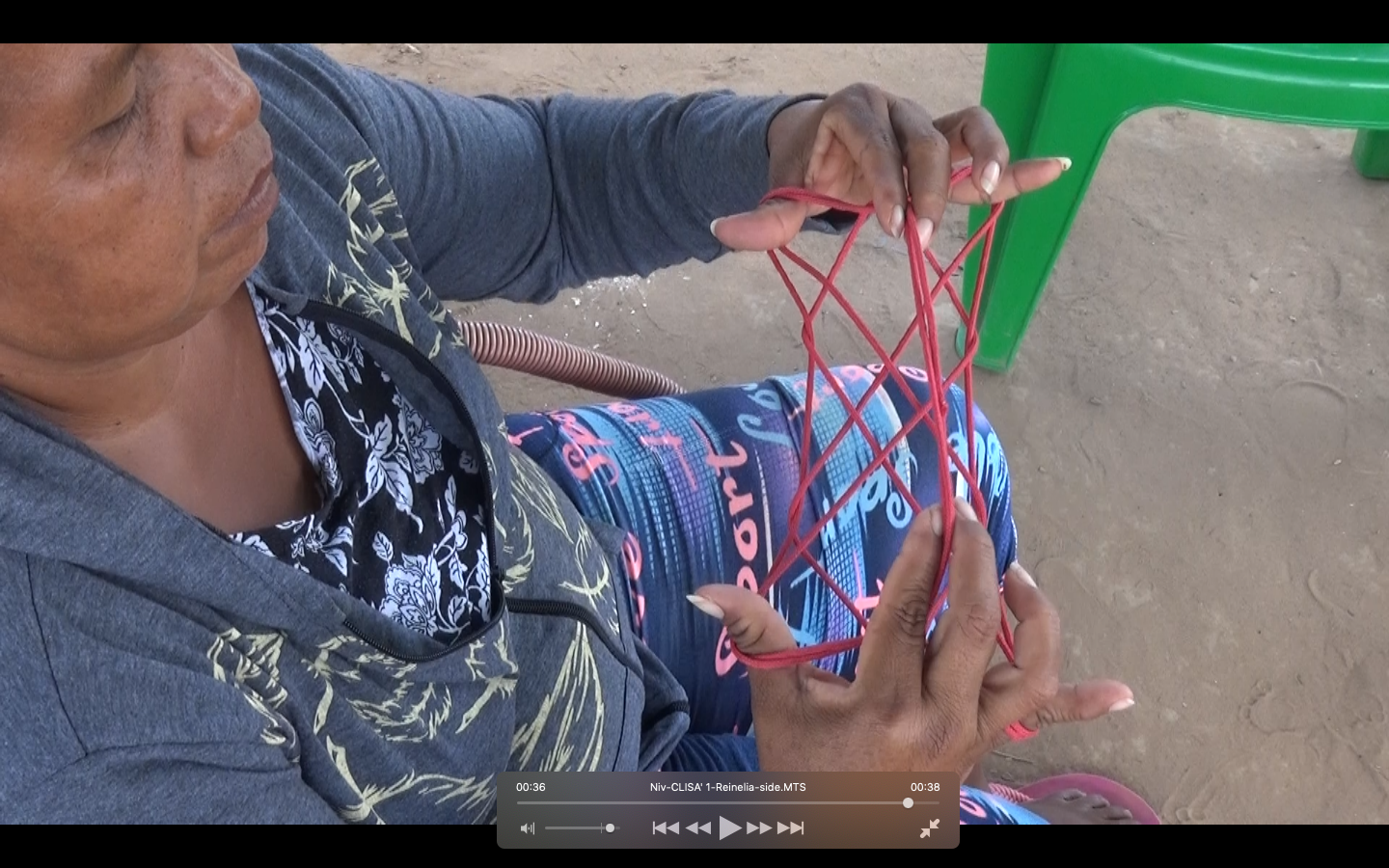
CLISA' (1), woven carrying bag
Geolocation
Citation
David Jabin, “CLISA' (1), woven carrying bag,” String figures, accessed October 9, 2026, https://stringfigures.huma-num.fr/items/show/79.
- Overall presentation
-
Name : CLISA' (1), woven carrying bag
-
Creator : David Jabin
-
Contributor(s) : Reinelia Pérez, village of Samaria, Nivacle Unida Comunity, Central Chaco, Paraguay
-
Date : 2019-2020
- Information on the string figure
The figure reprensents the CLISA (Niv.) more commonly called yica in the region. The yica is the traditionnal large carrying bag made of caraguatá fibers.
Caraguatá is very important technologic plant for chaquean indigenous people.
Caraguatá is very important technologic plant for chaquean indigenous people.
1. Opening A
2. Release 5. Extend.
3. Proximally, insert 5 into 2 loop
4. Proximally, insert 5 into 2 loops, pick up 2f and return.
5. With the help of R2 and proximal to both L2 and L3 loops, tranfer L5n to L1.
6. With the help of R2 and proximal to both L2 and L3 loops, tranfer L1f to L5.
Repeat on the right hand.
7. Distally, insert R2 and R3 into L2 and L3 loops respectively, pick up both palmar strings and return.
8. Distally, insert L2 and L3 into R2 and R3 loops respectively, pick up both palmar strings and return. Release the right hand.
9. Distally tranfer L2 and L3 loops to R1 and L5 respectively. Extend.
10. To display the figure, grasp the two central cross strings with 2 and 3.
2. Release 5. Extend.
3. Proximally, insert 5 into 2 loop
4. Proximally, insert 5 into 2 loops, pick up 2f and return.
5. With the help of R2 and proximal to both L2 and L3 loops, tranfer L5n to L1.
6. With the help of R2 and proximal to both L2 and L3 loops, tranfer L1f to L5.
Repeat on the right hand.
7. Distally, insert R2 and R3 into L2 and L3 loops respectively, pick up both palmar strings and return.
8. Distally, insert L2 and L3 into R2 and R3 loops respectively, pick up both palmar strings and return. Release the right hand.
9. Distally tranfer L2 and L3 loops to R1 and L5 respectively. Extend.
10. To display the figure, grasp the two central cross strings with 2 and 3.
The same final figure has been observeded among different south american indigenous groups (Chaco, Patagonia, central Brazil, Guayana).Rydén, S. (1934, p. 28, fig. 2(2): Toba-Pilagá, argentinian Chaco
Balducci (n°15, p. 142): Toba-Taksik, argentinian Chaco
Sturzenegger (8, p. 126).
Balducci (n°15, p. 142): Toba-Taksik, argentinian Chaco
Sturzenegger (8, p. 126).
- Item references
-
Key words : Nivacle string figure, method of construction, linguistic data, cultural aspects
-
Publisher : Laboratory SPHERE (UMR 7219, University of Paris & CNRS)
-
Rights : Creative Commons / Attribution-NonCommercial-ShareAlike 4.0 International License.
-
Format : If it is available, you can see the video with subtitles by clicking here If it is available, you can see the video with subtitles by clicking here
-
Language : Nivacle
-
Location : Village of Samaria, Boquerón Department, Paraguay, South America