
DAKUNA, magic stones
Geolocation
Citation
Eric Vandendriessche, “DAKUNA, magic stones,” String figures, accessed October 10, 2026, https://stringfigures.huma-num.fr/items/show/34.
- Overall presentation
-
Name : DAKUNA, magic stones
-
Creator : Eric Vandendriessche
-
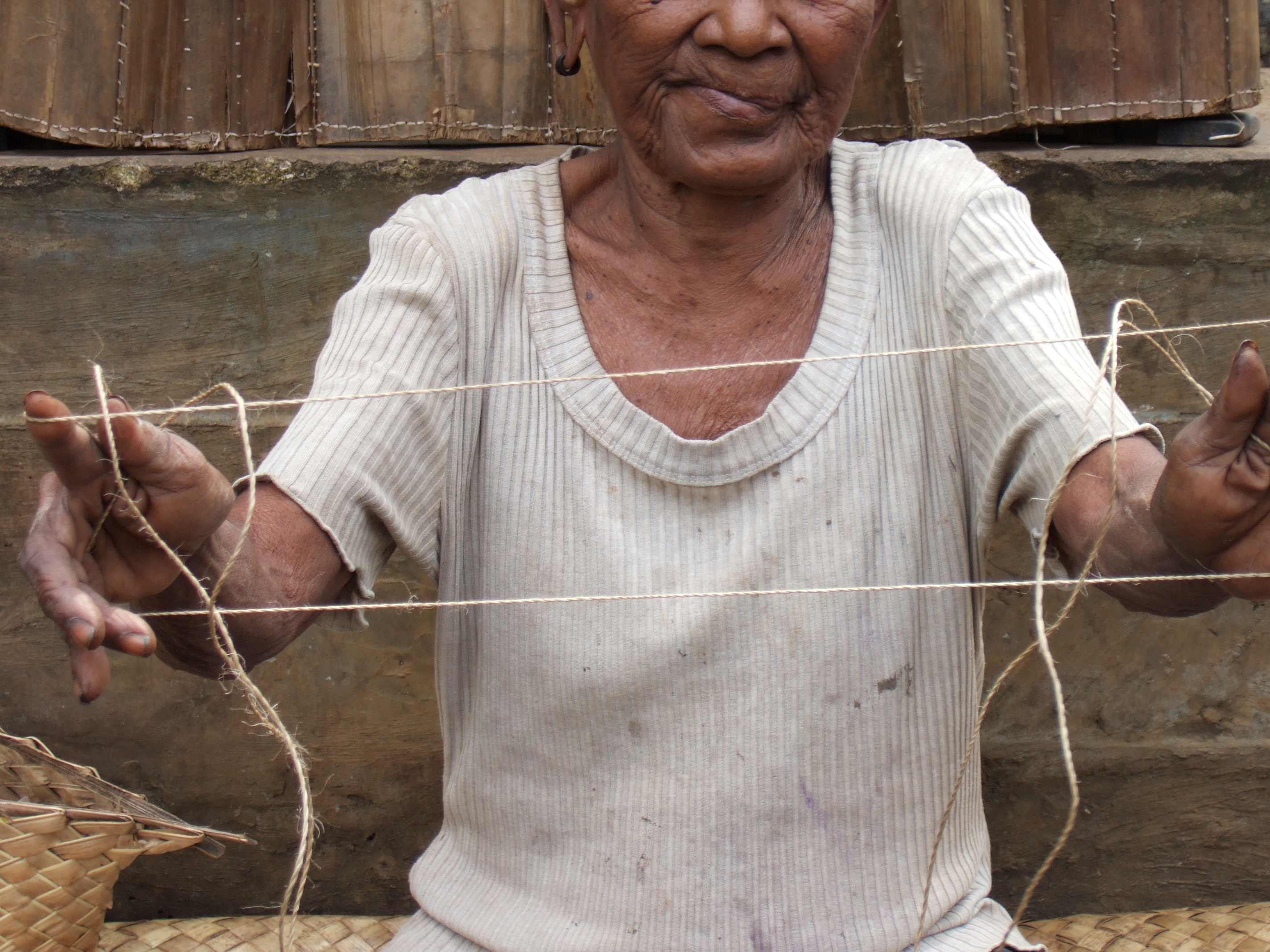
Contributor(s) : Morubikina, village of Oluvilei, Trobriand islands, Papua New Guinea
Bowelogusa, village of Oluvilei, Trobriand islands, Papua New Guinea -
Date : 2006-2007
- Information on the string figure
Tolobuwa, the village chief of Oluvilei, considers the string figure procedure dakuna to be referring to "magic stones". This string figure consists of a series of three procedures which differ from one another through the alteration of one and only one elementary operation.
This series of figures is punctuated by a recitative (vinavina). While the first figure is shown to the audience the practitioner says: duku yoyowa (they fly away). For the second figure he says: duku yoyowa – luku tota (they fly away – they remain standing). And finally, for the third one: duku tota (they remain standing).
In the Trobriand Islands, many stones are known to be used for various forms of magic. Some of the most widely known are those put into the big yam houses (liku) so that the tubers remain fresh and beautiful for the time they are stored in the liku.
However, the stones that the string figure dakuna refers to do not seem to have the same purpose: according to Tolobuwa, each village chief owns magic stones that he receives from his maternal uncle, and that he himself buries near his yam house (liku).
Each of these stones is said to contain a giant to whom the chief must ask frequently for some help with the gardening. If the chief does not comply with this prescription, the stones move away and never come back. Tolobuwa underlined
that the role of the string figure dakuna is thus to remind the chiefs that they have to use their magic stones if they don’t want to lose them. The string figure procedure dakuna thus appears as a memory support of a ritual prescription linked
to the gardens’ fertility.
This series of figures is punctuated by a recitative (vinavina). While the first figure is shown to the audience the practitioner says: duku yoyowa (they fly away). For the second figure he says: duku yoyowa – luku tota (they fly away – they remain standing). And finally, for the third one: duku tota (they remain standing).
In the Trobriand Islands, many stones are known to be used for various forms of magic. Some of the most widely known are those put into the big yam houses (liku) so that the tubers remain fresh and beautiful for the time they are stored in the liku.
However, the stones that the string figure dakuna refers to do not seem to have the same purpose: according to Tolobuwa, each village chief owns magic stones that he receives from his maternal uncle, and that he himself buries near his yam house (liku).
Each of these stones is said to contain a giant to whom the chief must ask frequently for some help with the gardening. If the chief does not comply with this prescription, the stones move away and never come back. Tolobuwa underlined
that the role of the string figure dakuna is thus to remind the chiefs that they have to use their magic stones if they don’t want to lose them. The string figure procedure dakuna thus appears as a memory support of a ritual prescription linked
to the gardens’ fertility.
1. Opening A
2 Pass 1 distal to 2 loops. Proximally, insert 1 into 5 loops, pick up 5n, and return to position.
Proximally, insert 2 into proximal 1 loops, pick up proximal 1f, and return to position. Release 1.Extend.
3. Figure 1: Distally, insert 1 into distal 2 loops, pick up 2f and return.
Figure 2: Pass R1 proximal to distal R2 loop, distally insert L1 into distal L2 loop,
pick up 2f and return.
Figure 3:Pass 1 proximal to distal 2 loops, pick up 2f and return.
5 pick up distal 2n and return.
Release distal 2 loops.
4. Proximally, insert 2 into 5 loops, pick up 5n and return. Release 5.
Proximally, insert 5 into distal 2 loops, transfer them to 5.
5. Pass 1 distal to 2 loops. Proximally, insert them into 5 loops.
Pick up 5n and return. Caroline extension
6. Release 2 and extend gently. Caroline extension
2 Pass 1 distal to 2 loops. Proximally, insert 1 into 5 loops, pick up 5n, and return to position.
Proximally, insert 2 into proximal 1 loops, pick up proximal 1f, and return to position. Release 1.Extend.
3. Figure 1: Distally, insert 1 into distal 2 loops, pick up 2f and return.
Figure 2: Pass R1 proximal to distal R2 loop, distally insert L1 into distal L2 loop,
pick up 2f and return.
Figure 3:Pass 1 proximal to distal 2 loops, pick up 2f and return.
5 pick up distal 2n and return.
Release distal 2 loops.
4. Proximally, insert 2 into 5 loops, pick up 5n and return. Release 5.
Proximally, insert 5 into distal 2 loops, transfer them to 5.
5. Pass 1 distal to 2 loops. Proximally, insert them into 5 loops.
Pick up 5n and return. Caroline extension
6. Release 2 and extend gently. Caroline extension
Figure 1:
$\underline{O}.A :\overrightarrow{m}1(2\infty): \underline{i}1(5\infty): p1(5n):\overrightarrow{m}2(u1f): \underline{i}2\left(l1\infty\right):p2\left(l1f \right):r1\mid \overline{i}1\left(u2\infty\right): p1\left(u2f \right):\overleftarrow{m}5(l\infty): p5(u2n): r(u2\infty)\mid \overrightarrow{m}2(u5n): \underline{i}2\left(l5\infty\right): p2\left(l5n\right): r5 \mid \underline{TF}\left(5, u2\infty \right):\overrightarrow{m}1(2\infty): \underline{i}1\left(5\infty\right): p1\left(5n\right):\underline{E}.C : r2 : \underline{E}.C \mid$
Figure 2:
$\underline{O}.A :\overrightarrow{m}1(2\infty): \underline{i}1(5\infty): p1(5n):\overrightarrow{m}2(u1f): \underline{i}2\left(l1\infty\right):p2\left(l1f \right): r1\mid\left\{\begin{array}{ c c } \overline{i}L1\left(Lu2\infty\right): pL1\left(Lu2f\right) \\ \overrightarrow{m}R1(Rl2\infty): pR1\left(Ru2f\right) \end{array}\right\}^{*}:\overleftarrow{m}5(l2\infty): p5(u2n): r(u2\infty)\mid
\overrightarrow{m}2(u5n): \underline{i}2\left(l5\infty\right):p2\left(l5n\right): r5 \mid \underline{TF}\left(5, u2\infty \right):\overrightarrow{m}1(2\infty): \underline{i}1\left(5\infty\right):p1\left(5n\right): \underline{E}.C : r2 : \underline{E}.C \mid$
Figure 3:
$\underline{O}.A :\overrightarrow{m}1(2\infty): \underline{i}1(5\infty): p1(5n):\overrightarrow{m}2(u1f): \underline{i}2\left(l1\infty\right):p2\left(l1f \right): r1\mid\overrightarrow{m}1(l\infty):p1(u2f): \overleftarrow{m}5(l2\infty): p5(u2n): r(u2\infty)\mid\overrightarrow{m}2(u5n): \underline{i}2\left(l5\infty\right):p2\left(l5n\right): r5 \mid \underline{TF}\left(5, u2\infty \right):\overrightarrow{m}1(2\infty): \underline{i}1\left(5\infty\right): p1\left(5n\right): \underline{E}.C : r2 : \underline{E}.C\mid$
$\underline{O}.A :\overrightarrow{m}1(2\infty): \underline{i}1(5\infty): p1(5n):\overrightarrow{m}2(u1f): \underline{i}2\left(l1\infty\right):p2\left(l1f \right):r1\mid \overline{i}1\left(u2\infty\right): p1\left(u2f \right):\overleftarrow{m}5(l\infty): p5(u2n): r(u2\infty)\mid \overrightarrow{m}2(u5n): \underline{i}2\left(l5\infty\right): p2\left(l5n\right): r5 \mid \underline{TF}\left(5, u2\infty \right):\overrightarrow{m}1(2\infty): \underline{i}1\left(5\infty\right): p1\left(5n\right):\underline{E}.C : r2 : \underline{E}.C \mid$
Figure 2:
$\underline{O}.A :\overrightarrow{m}1(2\infty): \underline{i}1(5\infty): p1(5n):\overrightarrow{m}2(u1f): \underline{i}2\left(l1\infty\right):p2\left(l1f \right): r1\mid\left\{\begin{array}{ c c } \overline{i}L1\left(Lu2\infty\right): pL1\left(Lu2f\right) \\ \overrightarrow{m}R1(Rl2\infty): pR1\left(Ru2f\right) \end{array}\right\}^{*}:\overleftarrow{m}5(l2\infty): p5(u2n): r(u2\infty)\mid
\overrightarrow{m}2(u5n): \underline{i}2\left(l5\infty\right):p2\left(l5n\right): r5 \mid \underline{TF}\left(5, u2\infty \right):\overrightarrow{m}1(2\infty): \underline{i}1\left(5\infty\right):p1\left(5n\right): \underline{E}.C : r2 : \underline{E}.C \mid$
Figure 3:
$\underline{O}.A :\overrightarrow{m}1(2\infty): \underline{i}1(5\infty): p1(5n):\overrightarrow{m}2(u1f): \underline{i}2\left(l1\infty\right):p2\left(l1f \right): r1\mid\overrightarrow{m}1(l\infty):p1(u2f): \overleftarrow{m}5(l2\infty): p5(u2n): r(u2\infty)\mid\overrightarrow{m}2(u5n): \underline{i}2\left(l5\infty\right):p2\left(l5n\right): r5 \mid \underline{TF}\left(5, u2\infty \right):\overrightarrow{m}1(2\infty): \underline{i}1\left(5\infty\right): p1\left(5n\right): \underline{E}.C : r2 : \underline{E}.C\mid$
Figure 1:
duku yoyowa (they fly away)
Figure 2:
duku yoyowa – luku tota (they fly away – they remain standing)
Figure 3:
duku tota (they remain standing).
duku yoyowa (they fly away)
Figure 2:
duku yoyowa – luku tota (they fly away – they remain standing)
Figure 3:
duku tota (they remain standing).
- Item references
-
Key words : String figures, Trobriand Islands, Magic
-
Publisher : Laboratory SPHERE (UMR 7219, University of Paris & CNRS)
-
Rights : Creative Commons / Attribution-NonCommercial-ShareAlike CC BY-NC-SA
-
Format : jpeg, mp4
-
Language : English, Kilivila
-
Location : Village of Oluvilei, Trobriand Islands, Papua New Guinea
-
Description : Trobriand string figure, method of construction, linguistic data, cultural aspects