
TULIMARJU(U)K, two ribs
Geolocation
Citation
Céline Petit, “TULIMARJU(U)K, two ribs,” String figures, accessed October 10, 2026, https://stringfigures.huma-num.fr/items/show/331.
- Overall presentation
-
Name : TULIMARJU(U)K, two ribs
-
Creator : Céline Petit
-
Contributor(s) : Herve PANIAQ, Iglulik, Nunavut, Canada
(and Celina IRNGAUT, interpreter, Iglulik) -
Date : 2011-2021
- Information on the string figure
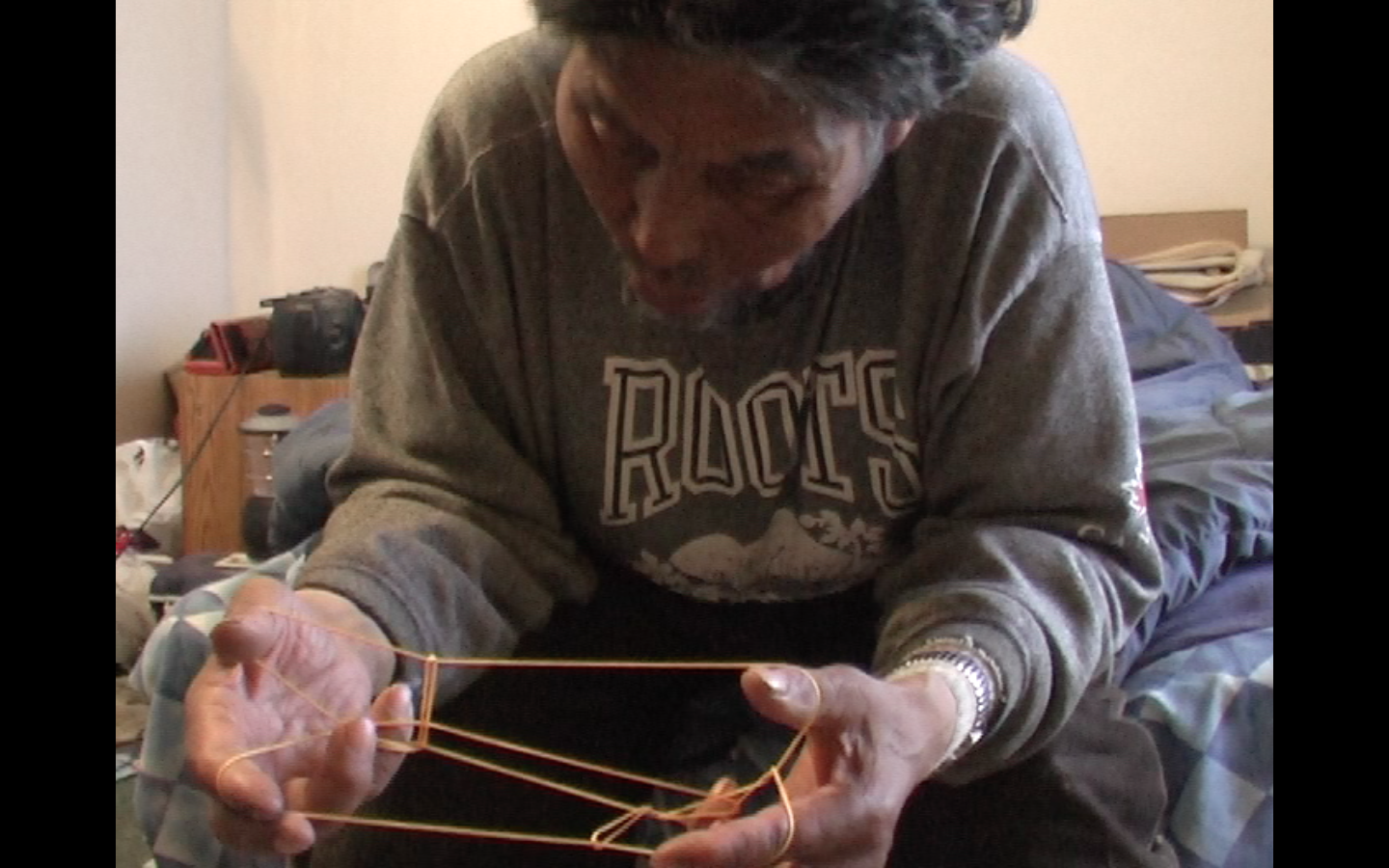
In the Iglulik area, this tridimensional figure is said to depict two ribs (tulimaak), most probably of a walrus (according to H. Paniaq).
This figure was documented in other Inuit societies, either with the same meaning ("two small ribs", Canadian central and eastern Arctic, and Greenland) or with a different interpretation ("the meeting of two brothers-in-law or two illuuk/illuriik", northern Alaska and Canadian central Arctic/Arviligjuarmiut).
This figure was documented in other Inuit societies, either with the same meaning ("two small ribs", Canadian central and eastern Arctic, and Greenland) or with a different interpretation ("the meeting of two brothers-in-law or two illuuk/illuriik", northern Alaska and Canadian central Arctic/Arviligjuarmiut).
1. Opening A.
2. 1, passing under 2 loop, picks up 2f and returns (under 2n). Release 2 loop. Proximally transfer 5 loop to 1.
3. Arrange 1 loops so that TV 1f is distal. 5 proximally enters triple 1 loops and hooks down (distal) TV 1f through 1 loops.
4. 2 picks up and removes the two non-TV 1n, leaving only the TV string on 1.
5. L Katilluik (= Bring 1 close to one another. L1 moves over R1n and picks it up proximally. Remove R1. R1 proximally enters both L1 loops,to share these loops with L1. 1 picks up the two 2f and returns through the two proximal 1 loops = Navajo 1. Release 2 loops).
6. There are now two TV 1n strings. One of the TV 1n strings has a loop that hangs from it near the left hand. Distally transfer this TV 1n string to 2, and spread apart 1 and 2 to open the figure (3-D figure).
The two transverse strings running in the center (or bottom) of the figure represent the spine, whereas the two vertical loops represent two ribs (of a walrus).
See Wirt & al. 2009: 58 for a step by step illustration.
2. 1, passing under 2 loop, picks up 2f and returns (under 2n). Release 2 loop. Proximally transfer 5 loop to 1.
3. Arrange 1 loops so that TV 1f is distal. 5 proximally enters triple 1 loops and hooks down (distal) TV 1f through 1 loops.
4. 2 picks up and removes the two non-TV 1n, leaving only the TV string on 1.
5. L Katilluik (= Bring 1 close to one another. L1 moves over R1n and picks it up proximally. Remove R1. R1 proximally enters both L1 loops,to share these loops with L1. 1 picks up the two 2f and returns through the two proximal 1 loops = Navajo 1. Release 2 loops).
6. There are now two TV 1n strings. One of the TV 1n strings has a loop that hangs from it near the left hand. Distally transfer this TV 1n string to 2, and spread apart 1 and 2 to open the figure (3-D figure).
The two transverse strings running in the center (or bottom) of the figure represent the spine, whereas the two vertical loops represent two ribs (of a walrus).
See Wirt & al. 2009: 58 for a step by step illustration.
H. Paniaq stresses that the beginning is here the same as for the string figure of the kayak (QAJARATTIAQ), whereas it continues the same way as for the figure of the two shoulder blades (KIASIATTIAK). These three string figures involve similar technics, ajjigiinguujaqtut.
"Tulimätciäk - two small ribs" (Coronation gulf/Inuinnait), "cäkєγik paqtuk - two brothers-in-law meet" (northern Inland Alaska/Nunamiut), Jenness 1924: 49, XXXVIII, fig. 50.
"Tulimar(sh)kuk - like the small ribs" (Craig Harbour, Cape York), "niηasuk - the rib" (Upernavik), Paterson 1949: 34, fig. 51, the rib.
"Tulimaarjuk - rib" (Tununirmiut), Mathiassen 1928: 189, 223.
"Tulimait" (Inughuit), Holtved 1967: 167, fig. 42.
"Idlortorjûk [illurturjuuk] - ceux qui (se battent) comme des idloq [illuuk]" (Arviligjuarmiut), Mary-Rousselière 1969: 90, fig. 78.
"Tulimât - ribs (the short ones that do not reach the breastbone)" (Upernavik), Hansen 1974: 219, 221, fig. 11. "Tulimartariik - two small ribs" (Kangirsujuamiut), Saladin d'Anglure 2003: 102-103, fig. 33.
"Tulimar(sh)kuk - like the small ribs" (Craig Harbour, Cape York), "niηasuk - the rib" (Upernavik), Paterson 1949: 34, fig. 51, the rib.
"Tulimaarjuk - rib" (Tununirmiut), Mathiassen 1928: 189, 223.
"Tulimait" (Inughuit), Holtved 1967: 167, fig. 42.
"Idlortorjûk [illurturjuuk] - ceux qui (se battent) comme des idloq [illuuk]" (Arviligjuarmiut), Mary-Rousselière 1969: 90, fig. 78.
"Tulimât - ribs (the short ones that do not reach the breastbone)" (Upernavik), Hansen 1974: 219, 221, fig. 11. "Tulimartariik - two small ribs" (Kangirsujuamiut), Saladin d'Anglure 2003: 102-103, fig. 33.
- Item references
-
Key words : String figure; String game; Inuit; Iglulik; Eastern Canada; Arctic
-
Publisher : Laboratory SPHERE (UMR 7219, University of Paris & CNRS)
-
Rights : Creative Commons / Attribution-NonCommercial-ShareAlike CC BY-NC-SA
-
Language : Inuktitut ; English
-
Location : Iglulik (Igloolik), Nunavut, Canada
-
Description : Iglulingmiut (Amitturmiut) Inuit string figure (Nunavut, Canada): symbolism, method of construction, references to the same figure as documented among different Inuit groups (Alaska, Canada, Greenland)