
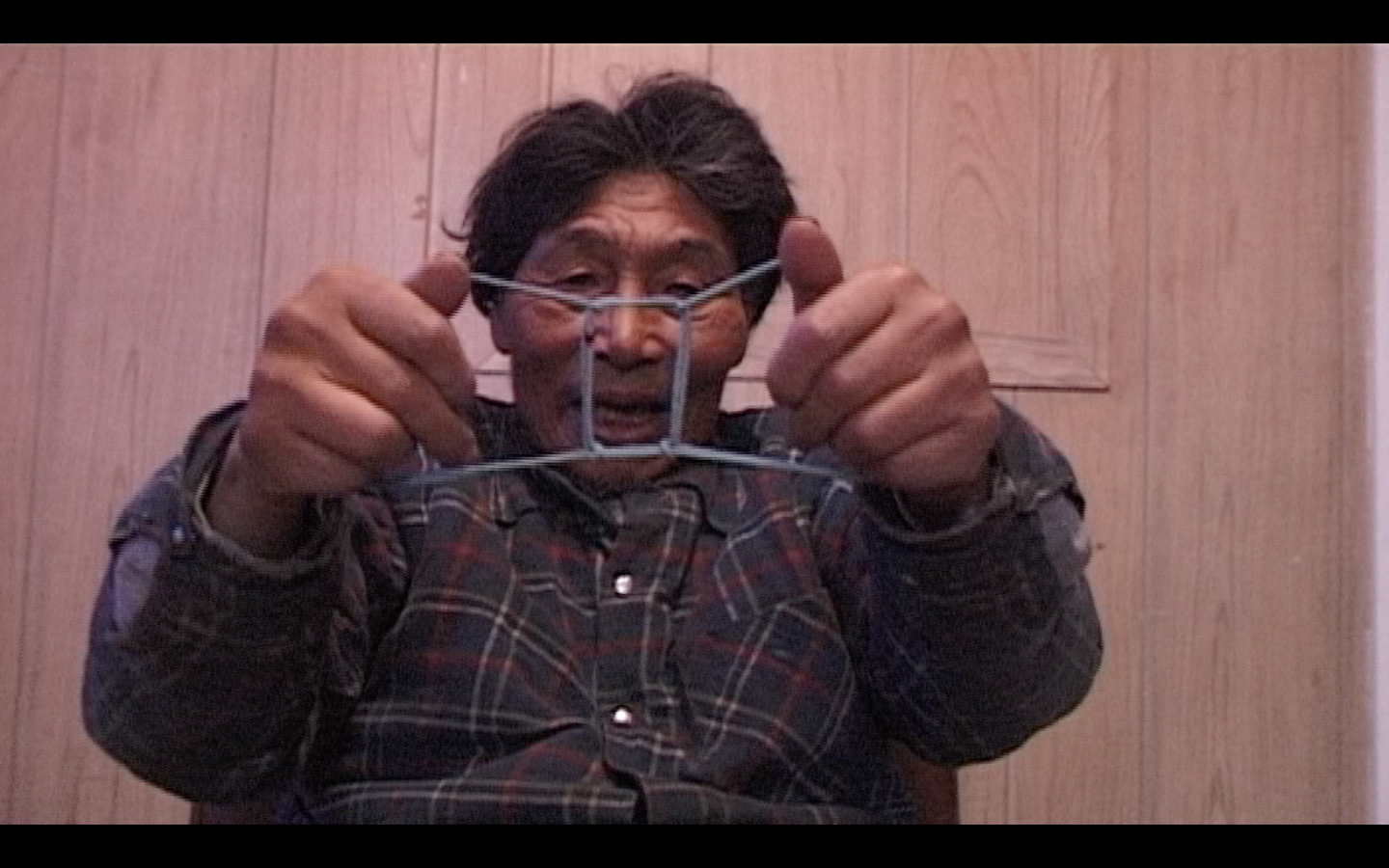
TUGALIATTIAQ, a square piece of ice
Geolocation
Citation
Céline Petit, “TUGALIATTIAQ, a square piece of ice,” String figures, accessed October 10, 2026, https://stringfigures.huma-num.fr/items/show/328.
- Overall presentation
-
Name : TUGALIATTIAQ, a square piece of ice
-
Creator : Céline Petit
-
Contributor(s) : Herve PANIAQ, Iglulik, Nunavut, Canada
Lucien UKALIANNUK, Iglulik.
-
Date : 2005-2021
- Information on the string figure
In the Iglulik area, this figure represents a block of ice which was extracted from a lake. Such a square piece of lake ice was traditionally used as a window in the sod house (qarmaq).
This figure does not seem to have been documented in other Inuit areas.
Its meaning seems a bit unclear since the word "tugaliaq" literally refers to a box made of ice slabs, or a dwelling made of ice slabs with tent or canvas over the top (Spalding 1998: 163). Regarding the terminology, there might be here some confusion with another string figure -cf. TU(U)GAATTIAQ- which was interpreted by some Iglulingmiut as referring to the ice or a piece of ice cut ("tuvaatsiaq", or also "tuvaliatsiaq"), and by others as the representation of a pair of walrus tusks, "tugatsiaq/k".
This figure does not seem to have been documented in other Inuit areas.
Its meaning seems a bit unclear since the word "tugaliaq" literally refers to a box made of ice slabs, or a dwelling made of ice slabs with tent or canvas over the top (Spalding 1998: 163). Regarding the terminology, there might be here some confusion with another string figure -cf. TU(U)GAATTIAQ- which was interpreted by some Iglulingmiut as referring to the ice or a piece of ice cut ("tuvaatsiaq", or also "tuvaliatsiaq"), and by others as the representation of a pair of walrus tusks, "tugatsiaq/k".
1. Opening B. (= Position 1. R2 hooks up L palmar string, rotating away from the body and pointing up. L2 proximally picks up L5n, which is also R2n. Extend. Remove 5.)
2. 5 enters 2 loop proximally (=from under), and hooks down 2n, closing to the palm.
3. 1 enters 2 loop proximally, picks up 2n and pulls it through the original 1 loop which slips off 1, 1 now pointing up (= Navajo 1). 2 are pointing up/away from the body.
4. 3 enters 1 loop proximally. On each side, there is a string closing the 1 loop (close to 1). 3 pushes that string toward the center and to the far side, passing under 2f. Bring L3 and R3 close to each other, pointing toward one another. With 2 still pointing up (and 1 pointing toward the body), exchange L3 and R3 loops the following way (behind the X formed in the center of the figure): Bend R3 and let L3 hook with its palm the string on the back of R3, thus removing it from R3. R3 then hooks the same way (with its palm) the lower L3 string on the back of L3, removing it from L3. Extend gently with 3 bent/hooked and pointing toward the body.
5. 3 moves toward the body, passing under 1 loop, and picks up 1n with its back, drawing it to the far side through the original 3 loop. 3 is now pointing away from the body.
6. Remove 1. Rotate 2 toward the body and close it to the palm. 1 passes over 1n, picks up 1f and enters 3 loop proximally.
7. Remove 2, then remove 3 and 5. From the far side/distally insert 345 into 1 loop. 345 hook down both 1f to the palm. Hands rotate so that palms are facing each other. Use 2 to adjust the figure, pushing down the "transversal" string that appears (within the pattern) above the lower TV (5) string forming the bottom of the pattern. A double-sided square is thus formed. This is the block of ice.
2. 5 enters 2 loop proximally (=from under), and hooks down 2n, closing to the palm.
3. 1 enters 2 loop proximally, picks up 2n and pulls it through the original 1 loop which slips off 1, 1 now pointing up (= Navajo 1). 2 are pointing up/away from the body.
4. 3 enters 1 loop proximally. On each side, there is a string closing the 1 loop (close to 1). 3 pushes that string toward the center and to the far side, passing under 2f. Bring L3 and R3 close to each other, pointing toward one another. With 2 still pointing up (and 1 pointing toward the body), exchange L3 and R3 loops the following way (behind the X formed in the center of the figure): Bend R3 and let L3 hook with its palm the string on the back of R3, thus removing it from R3. R3 then hooks the same way (with its palm) the lower L3 string on the back of L3, removing it from L3. Extend gently with 3 bent/hooked and pointing toward the body.
5. 3 moves toward the body, passing under 1 loop, and picks up 1n with its back, drawing it to the far side through the original 3 loop. 3 is now pointing away from the body.
6. Remove 1. Rotate 2 toward the body and close it to the palm. 1 passes over 1n, picks up 1f and enters 3 loop proximally.
7. Remove 2, then remove 3 and 5. From the far side/distally insert 345 into 1 loop. 345 hook down both 1f to the palm. Hands rotate so that palms are facing each other. Use 2 to adjust the figure, pushing down the "transversal" string that appears (within the pattern) above the lower TV (5) string forming the bottom of the pattern. A double-sided square is thus formed. This is the block of ice.
- Item references
-
Key words : String figure; String game; Inuit; Iglulik; Eastern Canada; Arctic
-
Publisher : Laboratory SPHERE (UMR 7219, University of Paris & CNRS)
-
Rights : Creative Commons / Attribution-NonCommercial-ShareAlike CC BY-NC-SA
-
Language : Inuktitut ; English
-
Location : Iglulik (Igloolik), Nunavut, Canada
-
Description : Iglulingmiut (Amitturmiut) Inuit string figure (Nunavut, Canada): symbolism, method of construction, references to the same figure as documented among different Inuit groups (Alaska, Canada, Greenland)