
TIRIGANNIARJUTTIAQ, fox
Geolocation
Relations
Item Relations
| This Item | related through common consecutive operations (sub-procedure): | Item: TIRIGANNIARJUTTIAK MAQRUUK, two foxes |
| Item: ULIGULIARJUTTIAQ, name of a man | related through common consecutive operations (sub-procedure): | This Item |
Graphical representation of this item’s relations
Citation
- Overall presentation
-
Name : TIRIGANNIARJUTTIAQ, fox
-
Creator : Céline Petit
-
Contributor(s) : Herve PANIAQ, Iglulik, Nunavut, Canada (video 1)
Zacharias Aqiaruq UQALIK, Iglulik
Margaret KIPSIGAK, Iglulik
Elisapi NUTARAKITTUQ, Iglulik
Abraham ULAAJURULUK, Iglulik
Mary Niriungniq QULIKTALIK, Iglulik
Susan AVINNGAQ, Iglulik
Elisapi AWA, Iglulik
Bonnie AMAAQ, Iglulik (video 2)
-
Date : 2004-2021
- Information on the string figure
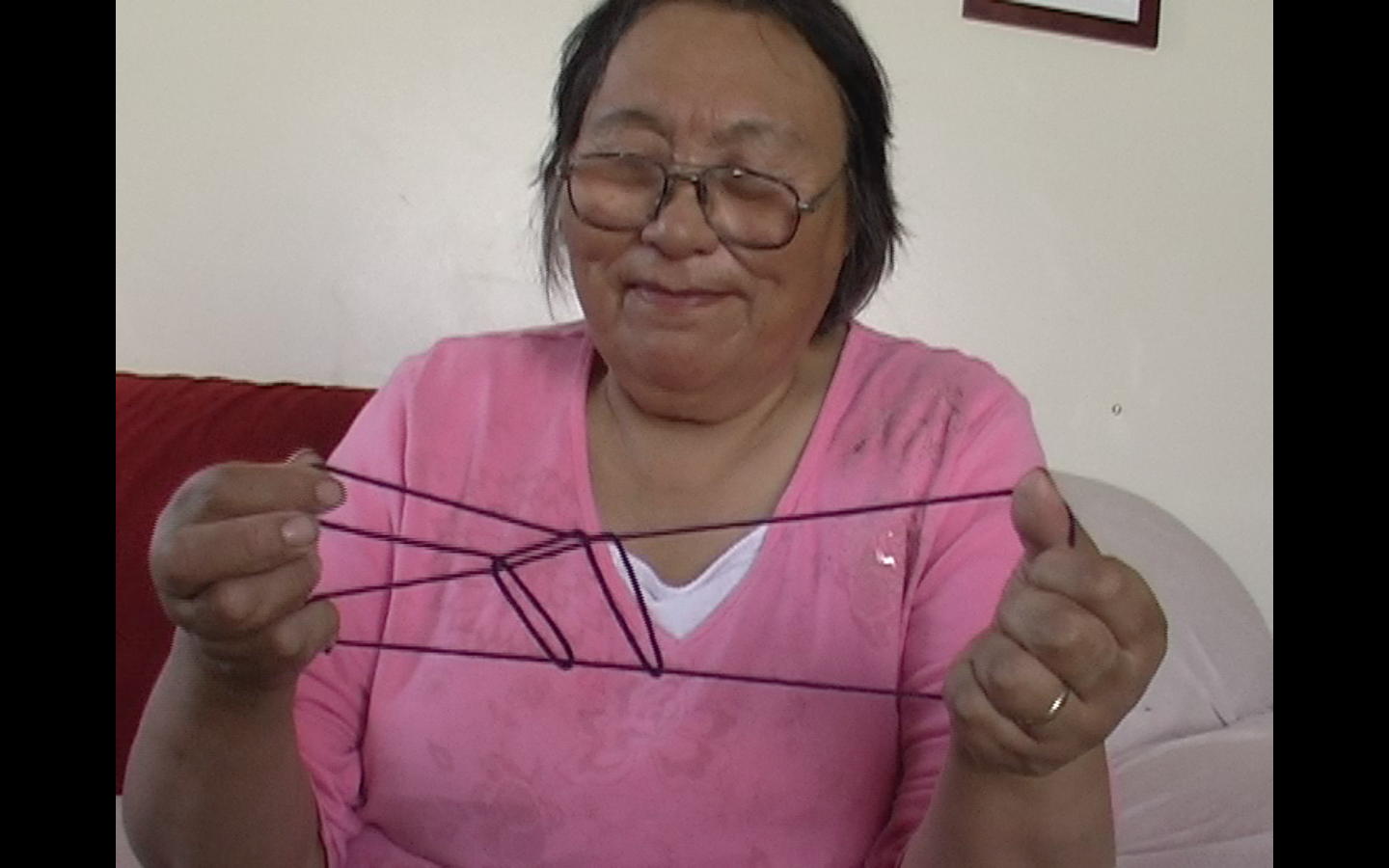
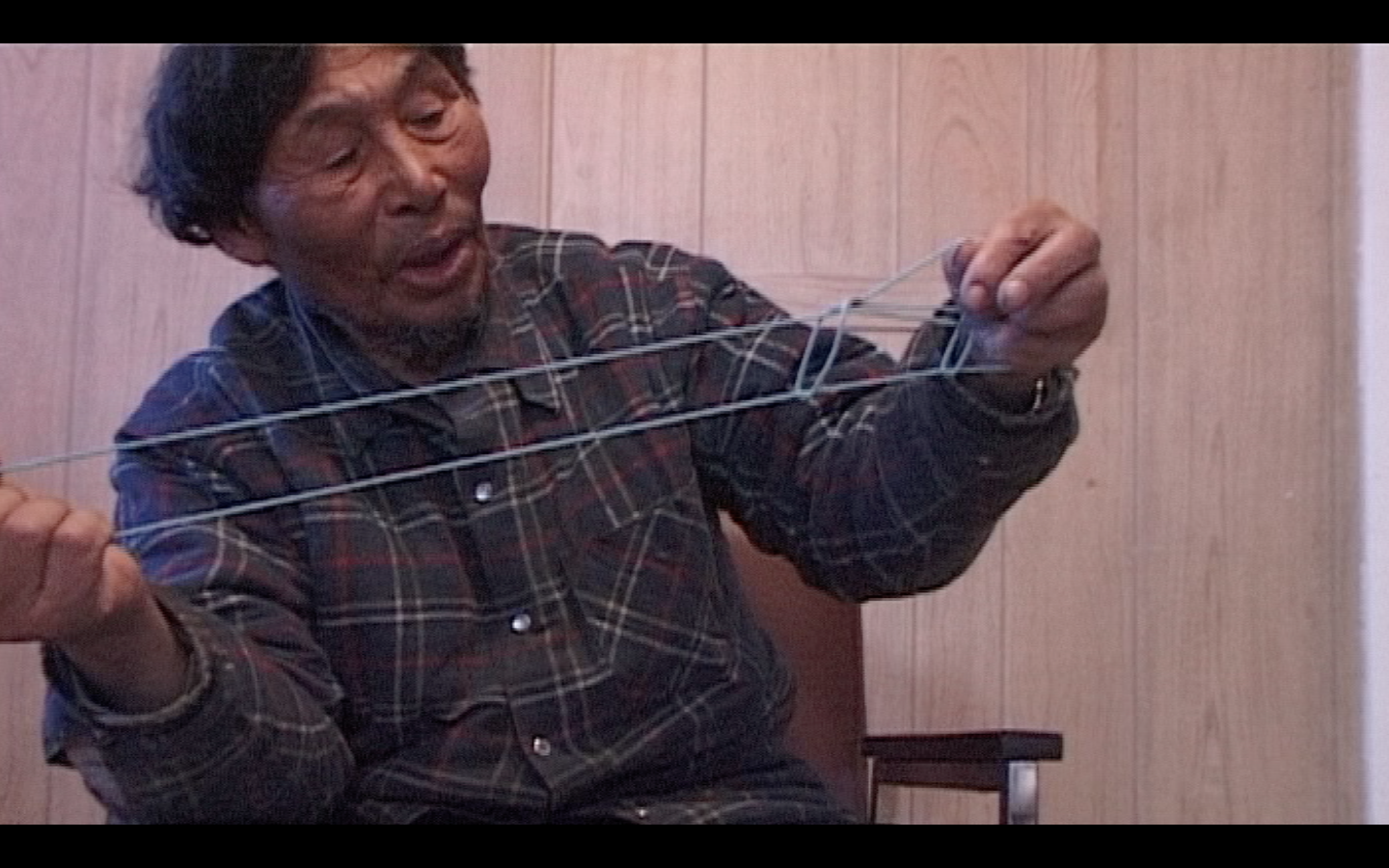
This pattern of the fox (or dog) is involved in several other string figures of the Inuit repertoires.
2. Bring hands close to one another, with palms facing down. R2 passes under the L1-L2 string segment and picks it up with its palm, pulling it slightly to the right and close to the palm (R2 thus remains bent). The palm of RH is now facing the body, while the palm of LH is facing down. Remove L1.
3. L1 enters distally R1 loop and picks up R1f-R2n string with its back, pulling it slightly to the left (= L1 returns with R1f-R2n on its back). Keep hands close to one another, with palms facing each other.
4. L1 enters proximally (=from below) L2 loop. Navajo L1 (= L1 picks up L2n and draws it through R1 loop / under lower L1n), L1 points up. Remove L2 and L(3)4.
5. Gently extend, with L1 pulling upward to the left and R2 bent towards the body, drawing its loop to the right through R1 loop (= passing under R1f) and then pointing up. Remove R(3)4, R1, then L5. L2345 enter distally (=from the far side) L1 loop, grab L1f and close to the palm. Remove L1. The fox appears.
6. By swaying the LH (pulling the upper TV string to the left) the fox is made to gallop to the right.
To create the figure of the fox running to the left, invert the hands' order (starting thus with L2 picking up with its palm the R1n-R2n string) after Opening C.
"Teriangniarssuk - fox" (Aivilingmiut, Tununirmiut), Mathiassen 1928: 222.
"Teriania(sh)ku·tien - the fox" (Craig Harbour, Tununirmiut), "qim·ɛq - dog" (Upernavik), "qim·iq - dog" (Cape York), Paterson 1949: 17, fig. 9.
"Teriganiarjuk - le renard" (Arviligjuarmiut), Mary-Rousselière 1969: 18-19, fig. 14a.
- Item references
-
Key words : String figure; String game; Inuit; Iglulik; Eastern Canada; Arctic
-
Publisher : Laboratory SPHERE (UMR 7219, University of Paris & CNRS)
-
Rights : Creative Commons / Attribution-NonCommercial-ShareAlike CC BY-NC-SA
-
Language : Inuktitut ; English
-
Location : Iglulik (Igloolik), Nunavut, Canada
-
Description : Iglulingmiut (Amitturmiut) Inuit string figure (Nunavut, Canada): symbolism, method of construction, references to the same figure as documented among different Inuit groups (Alaska, Canada, Greenland)