
QILAUJJAQTUAQTUQ, the drum-dancer
Geolocation
Citation
- Overall presentation
-
Name : QILAUJJAQTUAQTUQ, the drum-dancer
-
Creator : Céline Petit
-
Contributor(s) : Herve PANIAQ, Iglulik, Nunavut, Canada (videos 1 & 2)
Bonnie AMAAQ, Iglulik (video 3)
Lucien UKALIANNUK, Iglulik
Elisapi NUTARAKITTUQ, Iglulik
Mary Niriungniq QULIKTALIK, Iglulik -
Date : 2005-2021
- Information on the string figure
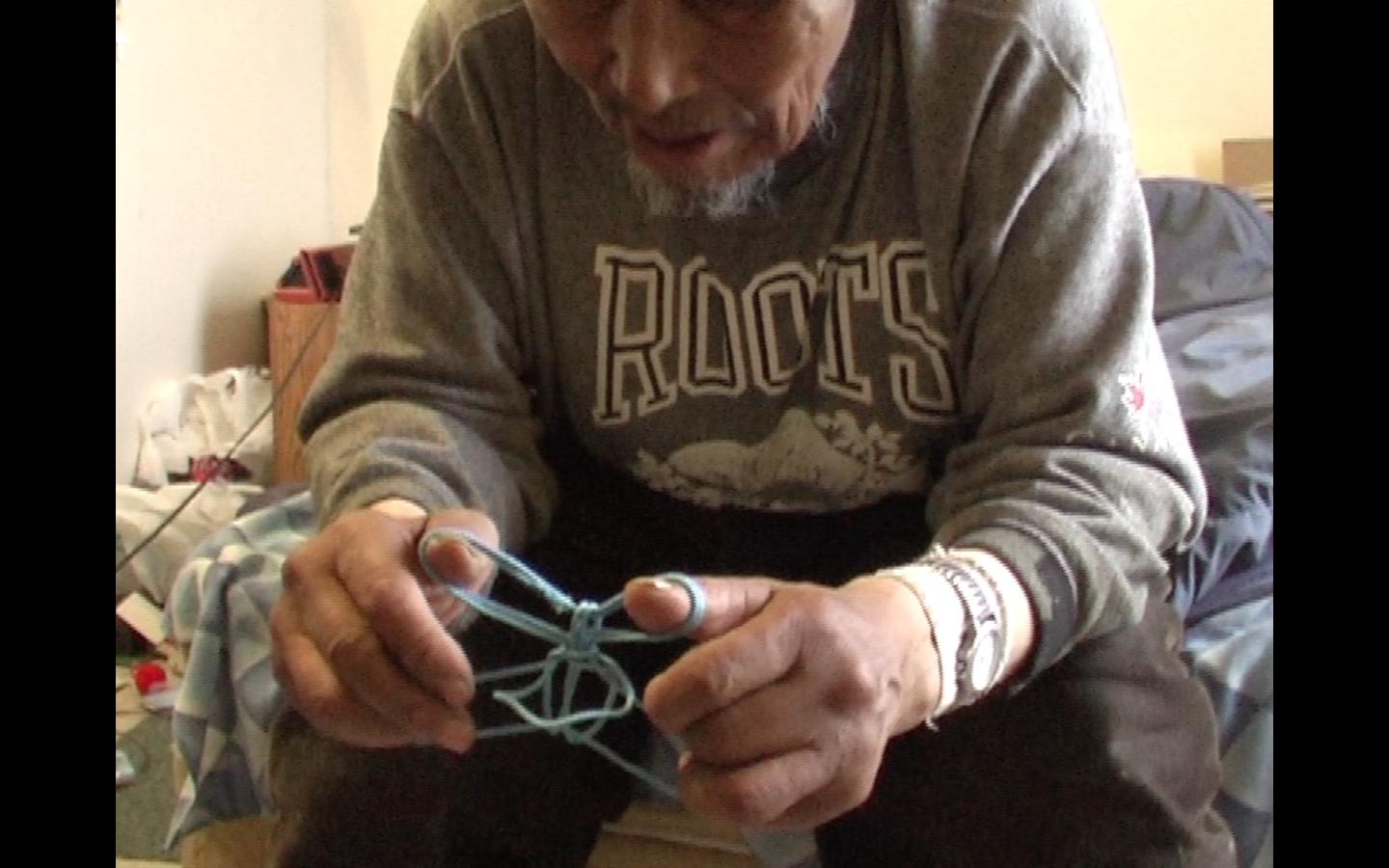
According to Herve Paniaq, the body of the character depicted here appears short since the man is bent down, in the traditional position of the drum-dancer.
Such a string figure was recorded mostly in Inuit societies described -in the classical ethnography- as forming the "Iglulik group" (Aivilingmiut, Amitturmiut/Iglulingmiut, Tununirmiut), and among Kivallirmiut (groups of the "Caribou" Inuit, west of Hudson Bay) like the Qairnirmiut.
2. R1 picks up the L1n-L2f palmar string. L1 picks up R1n-R2f palmar string between R1n and R1f. Remove 345 and extend.
3. 5 enters proximally/from below lower 1 loop. Pushing TV 1f away from the body, 5 passes under upper 1f on each side (= gets into the X, on each side) and hooks down 2n (through 5 loop), then closing to the palm.
4. 3 proximally enters 2 loop. With the help of 3, 2 hooks up double 1n (double 1n is seized between the 2 and 3 fingertips, with 3 under and 2 over) through the 2 loop, 2 rotating down away from the body then pointing up. Remove 3.
5. R1 enters proximally/from below double L1 loop. Remove L1. L1 proximally enters quadruple R1 loop. 1 picks up double 2n (close to 2). Navajo 1 by lifting the quadruple lower loop over the double upper loop then off the tips of 1 (but keep the four released strings resting on the double dorsal string segments running from 1 to 2 at the same hand). = R Katilluik.
6. Remove 2 and extend (with 1 pointing upwards, 5 still hooked close to the palm and palms facing each other). Adjust the figure to make the drum appear neatly (perpendicular to the character).
The string depicting the drum is the one to be pulled to dissolve the figure in one move.
"Qilaujaqtuq" (Tununirmiut), Mathiassen 1928: 223.
"Angakok - shaman" (Qairnirmiut, Baker Lake), Michéa 1949: 183-187. Cf. Claassen, BISFA vol. 20, 2013: 155-156, 169-170.
"Qilaudjartuartuq - le batteur de tambour", Mary-Rousselière 1973: 2.
- Item references
-
Key words : String figure; String game; Inuit; Iglulik; Eastern Canada; Arctic
-
Publisher : Laboratory SPHERE (UMR 7219, University of Paris & CNRS)
-
Rights : Creative Commons / Attribution-NonCommercial-ShareAlike CC BY-NC-SA
-
Language : Inuktitut ; English
-
Location : Iglulik (Igloolik), Nunavut, Canada
-
Description : Iglulingmiut (Amitturmiut) Inuit string figure (Nunavut, Canada): symbolism, method of construction, references to the same figure as documented among different Inuit groups (Alaska, Canada, Greenland)