
VALHAY, pigeons
Geolocation
Citation
David Jabin, “VALHAY, pigeons,” String figures, accessed October 10, 2026, https://stringfigures.huma-num.fr/items/show/290.
- Overall presentation
-
Name : VALHAY, pigeons
-
Creator : David Jabin
-
Contributor(s) : Elena Unruh
-
Date : 2019-2020
- Information on the string figure
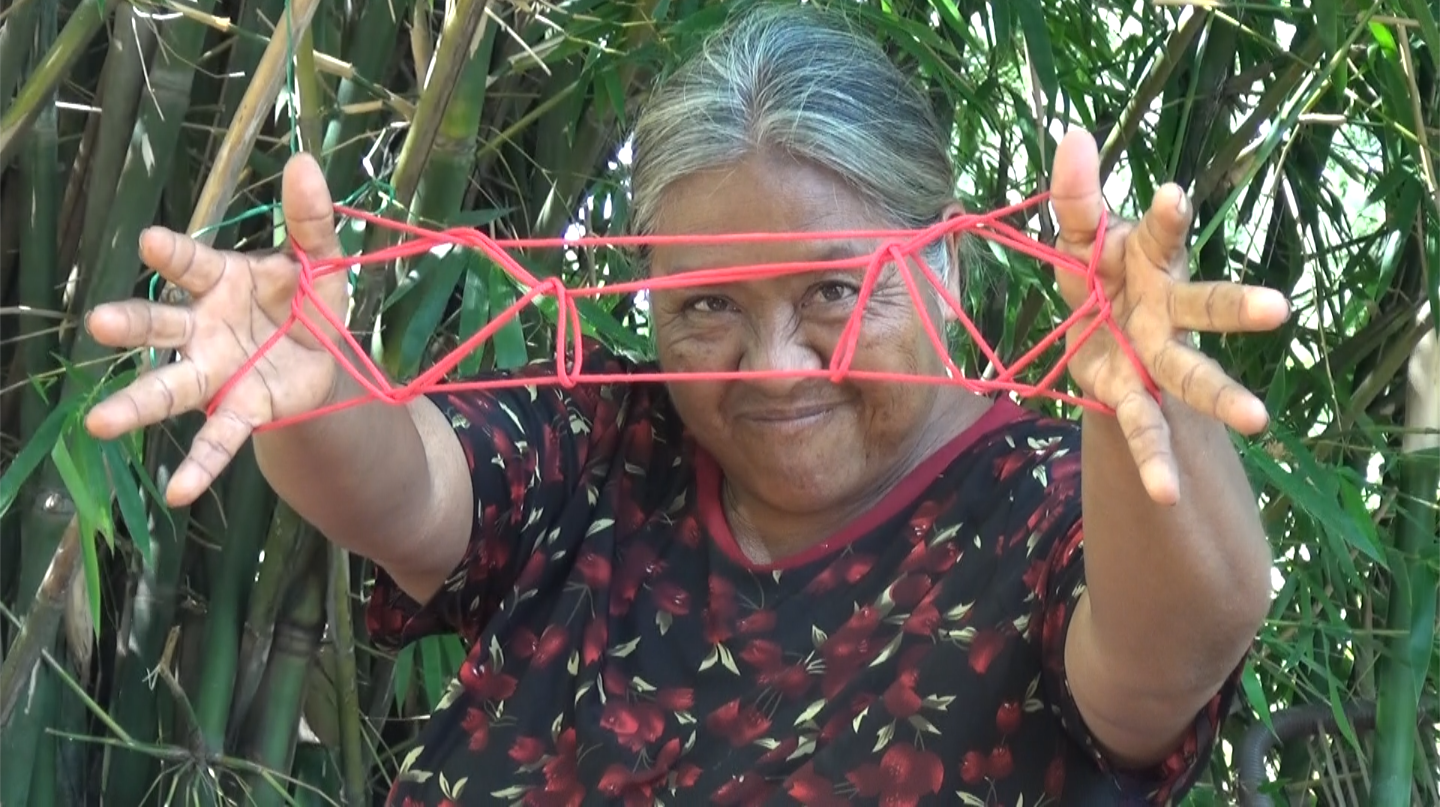
This figure seems to have been widespread throughout the Chaco region, where it generally represents two birds facing each other in lateral view. Among the Enlhet of Yalve Sanga, it is called VALHAY which means "the pigeons".
1. Insert L1 in the loop.
2. Wrap L1n around L1.
3. Proximally, insert R1 in L1 loop.
4. Proximally, insert 5 in the large hanging loop and extend.
5. R2 picks up L palmar string and L2 picks up R palmar string. Extend.
6. Distally, insert 2 in 5 loop and twist
7. Transferring 5 loop to 2 twit it 360° anticlockwise.
8. Twist both 2 loops 360° anticlockwise.
9. 1 pick up both 2f and return.
10. With the teeth, seize alternatively the L2n lower string and R2n lower strings near finger to release the lower 2 loops.
11. With the teeth, seized alternatively both lower L1n and both lower R1n to release the lower 1 loops.
12. Distally, transfer 2 loops to 5. Rearange.
13. Very carefully, maintaining the general structure of the figure, release the 1 loops.
14. Proximally insert 1 in each of the small most external triangles which one of the side are formed by the former double 1n string.
15. Rearrange and stretch the figure slowly. Slightly loosen the figure: a transverse thread hangs just below the figure.
16. Distally Insert 2 in 1 loops and hook up the hanging transverse loop.
17. Release 1.
18. Distally transfer 2 loops to 1.
19. Extend arms away from you to display the figure.
2. Wrap L1n around L1.
3. Proximally, insert R1 in L1 loop.
4. Proximally, insert 5 in the large hanging loop and extend.
5. R2 picks up L palmar string and L2 picks up R palmar string. Extend.
6. Distally, insert 2 in 5 loop and twist
7. Transferring 5 loop to 2 twit it 360° anticlockwise.
8. Twist both 2 loops 360° anticlockwise.
9. 1 pick up both 2f and return.
10. With the teeth, seize alternatively the L2n lower string and R2n lower strings near finger to release the lower 2 loops.
11. With the teeth, seized alternatively both lower L1n and both lower R1n to release the lower 1 loops.
12. Distally, transfer 2 loops to 5. Rearange.
13. Very carefully, maintaining the general structure of the figure, release the 1 loops.
14. Proximally insert 1 in each of the small most external triangles which one of the side are formed by the former double 1n string.
15. Rearrange and stretch the figure slowly. Slightly loosen the figure: a transverse thread hangs just below the figure.
16. Distally Insert 2 in 1 loops and hook up the hanging transverse loop.
17. Release 1.
18. Distally transfer 2 loops to 1.
19. Extend arms away from you to display the figure.
Rydén (1934: n ° 6, p.32) presents the drawing of a figure with an almost identical final pattern that he collected from the Toba of Sombrero Negro, in the Argentinian Chaco and whose meaning is identical ("two pigeons "). Rydén also informs us that a similar figure was collected by Nordenskiöld in 1908-1909 from the Choroti with the meaning of "caraguatá".
Martinez crovetto (http://collections.smvk.se/carlotta-vkm/web/object/53067) has collected a figure with identical final pattern and a fairly close meaning ("two ducks") among the Mocovi of the argentinian Chaco.
We have no informations about the construction of this first three figures.
Nonetheless Braustein (1992a: n°39) presents a figure with a similar final patterna, different construction method and the meaning of doca “fruits”.
Martinez crovetto (http://collections.smvk.se/carlotta-vkm/web/object/53067) has collected a figure with identical final pattern and a fairly close meaning ("two ducks") among the Mocovi of the argentinian Chaco.
We have no informations about the construction of this first three figures.
Nonetheless Braustein (1992a: n°39) presents a figure with a similar final patterna, different construction method and the meaning of doca “fruits”.
- Item references
-
Key words : String figures, Enlhet, paraguayan Chaco
-
Publisher : Laboratory SPHERE (UMR 7219, University of Paris & CNRS)
-
Rights : Creative Commons / Attribution-NonCommercial-ShareAlike CC BY-NC-SA
-
Format : jpeg, mp4, text
-
Language : Enlhet, spanish
-
Location : Village of Efeso, Yalve Sanga indigenous community, Central Chaco, Paraguay, South America
-
Description : Enlhet string figure, method of construction, linguistic data, cultural aspects