
CLISA' (2)
Citation
- Overall presentation
-
Name : CLISA' (2)
-
Creator : David Jabin
-
Contributor(s) : Rosa Fermin, village of Tiberia, Nivacle Unida Comunity, Central Chaco, Paraguay (for the figure).
Reinelia Pérez, village of Samaria, Nivacle Unida Comunity, Central Chaco, Paraguay (for the video). -
Date : 2019-2020
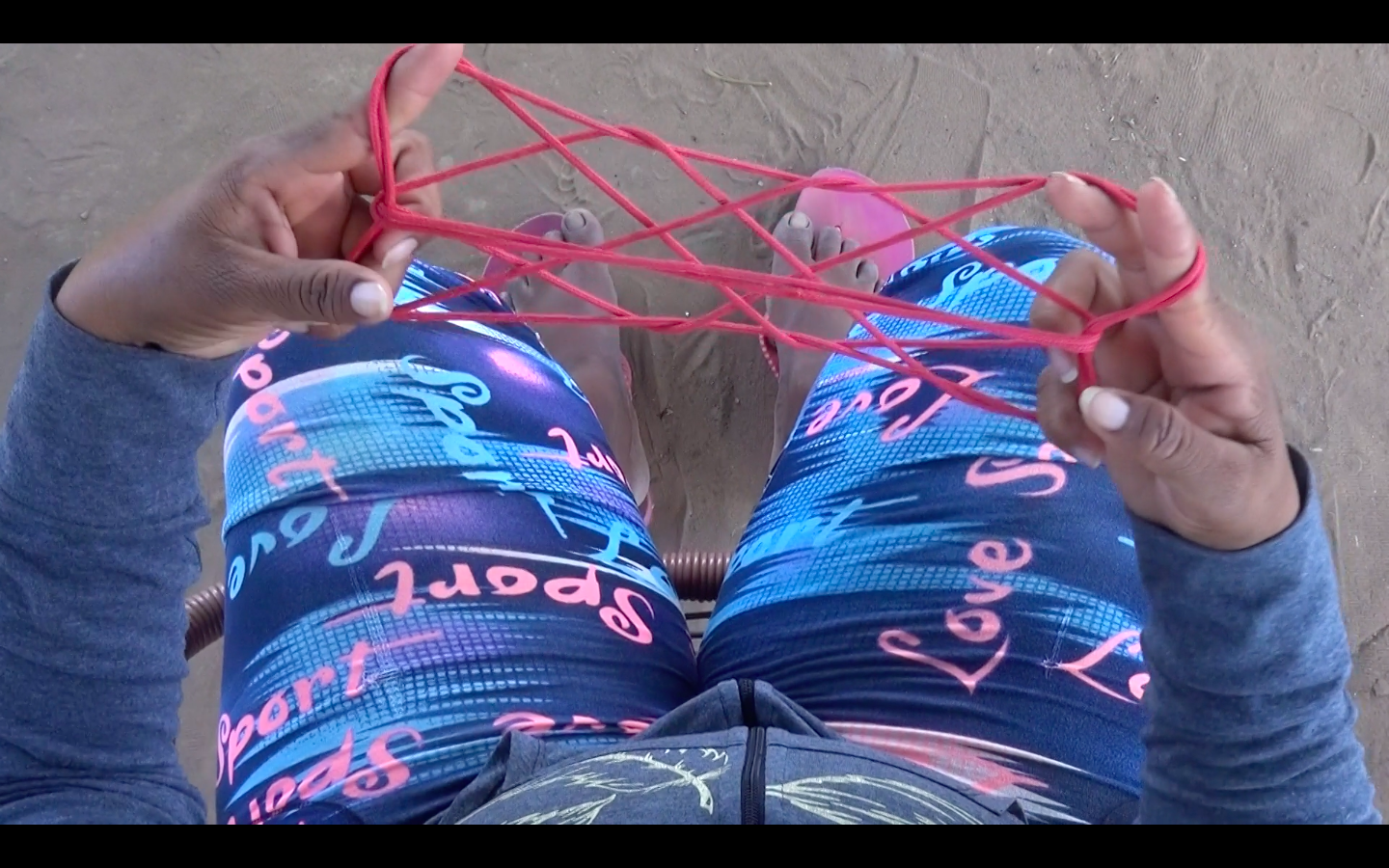
- Information on the string figure
2. Release 5. Extend.
3. Proximally, insert 5 into 2 loops, pick up 2f and return.
4. R3 pick up L2f and return.
5. L3 picks up R2-R5 palmar string and return.
6. Distally, inset R3 into L3 loop, pick up L2-L5 palmar string and return.
7. 1 pass distal to 2 and 3 loops, pick up 5n and return.
8. 5 pass distal to 3 and 2 loops, pick up 1n and return.
9. 2 and 3 pass distal to both palmar strings enter distally in their own loops.
10. Release 1 and 5. Extend.
11. Rotate both hands 180°anticlockwise/
12. Then extend 2 while rotating both hands 180° inside.
13. 1 slightly lift both transverse strings.
See Brausnstein (2017) p. 129: this figure has a widespread distribution throughout South America in the lowlands with very different symbolism. Chaco: Nivacle Pilcomayo, Ñandeva, Toba-Pilaga (Ryden), Toba Tasksik. Xingu: Baikari; Patagonia (Araucanos), Guayana (Warrau, Akawai), northwest Amazonia (Tukano: close variant).
- Item references
-
Key words : Description the Nivacle string figure representing a CLISA , a woven carrying bag, among the NIvacle of teh paraguaya Chaco. Symbolism, method of construction, references to the same figure has been collected within different south american indigenous groups (Chaco, Patagonia, central Brazil, Guayana).
-
Publisher : Laboratory SPHERE (UMR 7219, University of Paris & CNRS)
-
Rights : Creative Commons / Attribution-NonCommercial-ShareAlike 4.0 International License.
-
Format : If it is available, you can see the video with subtitles by clicking here If it is available, you can see the video with subtitles by clicking here
-
Language : Nivacle
-
Location : Village of Samaria, Boquerón Department, Paraguay, South America
-
Description : The figure reprensents the CLISA (Niv.) more commonly called yica in the region. The yica is the traditionnal large carrying bag made of caraguatá fibers.
Caraguatá is very important technologic plant for chaquean indigenous peoples.
In this database there are 3 variants of the CLISA' figure, two were found among the Nivacle and one among the Enlhet (see AYEN). Unlike the other two variants, CLISA '(2) does not appear to be part of a progressive series.