
FTSÔNAJ 1, suncho branch
Geolocation
Citation
David Jabin, “FTSÔNAJ 1, suncho branch,” String figures, accessed October 10, 2026, https://stringfigures.huma-num.fr/items/show/120.
- Overall presentation
-
Name : FTSÔNAJ 1, suncho branch
-
Creator : David Jabin
-
Contributor(s) : Evelia Pérez and Reinelia Pérez, Samaria village, Nivacle Unida comunity, Central Chaco, Paraguay.
-
Date : 2019-2020
- Information on the string figure
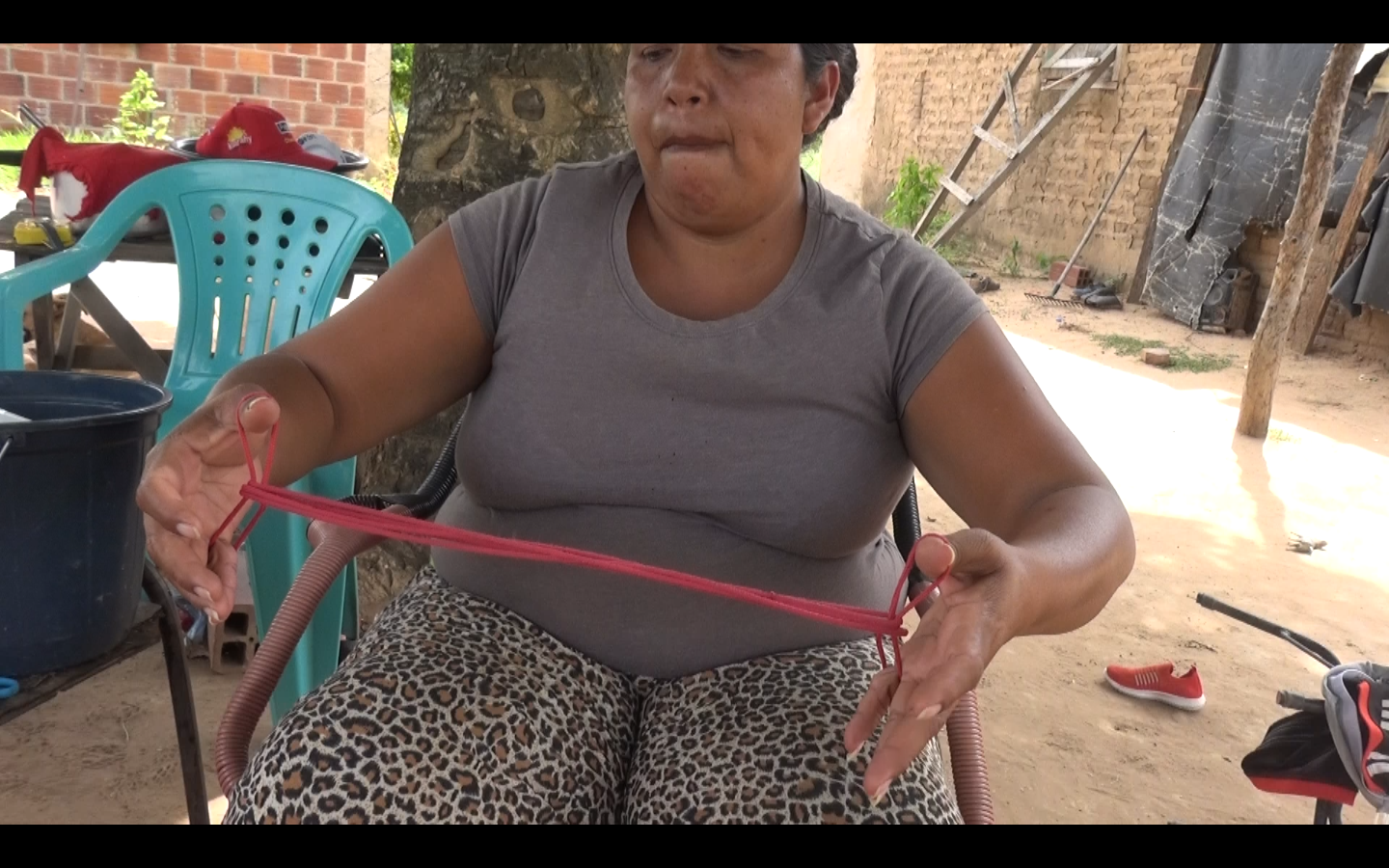
The final figure, one of the first figures that children learn, represents a bunch of branches of the FTSÔNAJ plant (Saccharis salicifolia, “suncho” in the regional spanish) used as grill stick. This bushy plant is characteristic of the sandy banks of the Chaco water points and of the Pilcomayo River, which runs through the extreme south of the region where the Nivacle people now live. The FSTÔNAJ plant is strongly linked to fishing activities. For the inhabitants of the Chaco its thin, stiff branches serve to make a grill stick who do not give the fish a bad taste to the fish food. This plant is also has a propitiatory use in different groups of the Chaco: in this case small bunches of leaves are tied to the ends of the fishing net (Scarpa, 2007: 336, describe this used among Chorote).
1. Position I: insert L15 and R15 in the loop
2. R1 picks up the left palmar string.
3. Repeat with left hand.
4. Insert 1 in 5 loop passing distally to 1f and 5n, pick up 5f and return.
5. Pass distal to all three 1f strings, insert 1 in the tiny 5 loops and return.
6. Release the three 1 lower loops, extend and display horizontally.
2. R1 picks up the left palmar string.
3. Repeat with left hand.
4. Insert 1 in 5 loop passing distally to 1f and 5n, pick up 5f and return.
5. Pass distal to all three 1f strings, insert 1 in the tiny 5 loops and return.
6. Release the three 1 lower loops, extend and display horizontally.
- Item references
-
Key words : String figures, Nivacle, paraguayan Chaco
-
Publisher : Laboratory SPHERE (UMR 7219, University of Paris & CNRS)
-
Rights : Creative Commons / Attribution-NonCommercial-ShareAlike CC BY-NC-SA
-
Format : jpeg, mp4, text
-
Language : Spanish
-
Location : Village of Samaria, Boquerón Department, Paraguay, South America.
-
Description : Nivacle string figure, method of construction, linguistic data, cultural aspects