
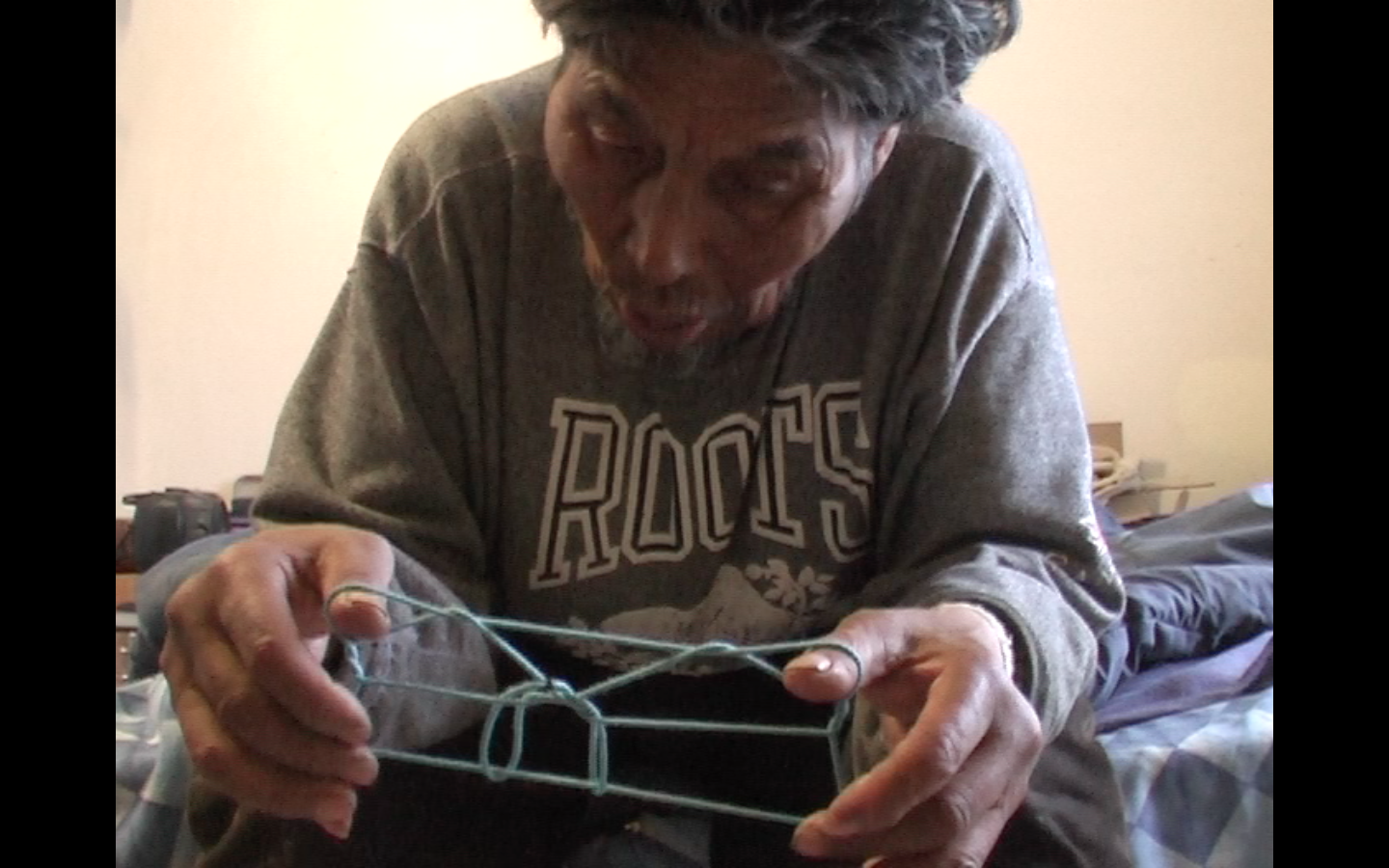
KATAGJUK, the entrance
Geolocation
Relations
Item Relations
| Item: NURRAATTIAK, the two caribou fawns | related through common consecutive operations (sub-procedure): | This Item |
Graphical representation of this item’s relations
Citation
- Overall presentation
-
Name : KATAGJUK, the entrance
-
Creator : Céline Petit
-
Contributor(s) : Herve PANIAQ, Iglulik, Nunavut, Canada (video 1)
(and Charlie UTTAK, interpreter, Iglulik)
Bonnie AMAAQ, Iglulik (video 2)
Elisapi NUTARAKITTUQ, Iglulik -
Date : 2005-2021
- Information on the string figure
2. Bend 2 down over 2f and 5 loop (and close to the palm). 2 moving towards the body enter proximally into 1 loop and hook up 1n (then rotating back, away from the body, to point upwards).
Release 1 loop.
3. 1 enter distally into proximal 2 loop, then (under all the remaining strings) pick up 5f.
4. Hook 1 over distal 2n, and pull down that string to the palm so that the existing 1 loop slips off. Pass 1 away from you under all strings except 5n, then bend 1 toward the center of the figure, pick up 5n with the side of 1 and return through 1 loop.
Point 1 away from you and below the figure.
5. With 1 pick up the lower TV string, drawing the string through the 1 loop, then release 2 loops. Orient hands so that fingers point away, 1 is on top and 5 at the bottom.
See Wirt & al. 2009: 291-292 for a step by step illustration.
"A man carrying a kayak", Jenness 1924: 42, XXXII, fig. 41. Collected among several Inuit groups of the Western Arctic, under the names MAQIQTUAQTUQ (Barrow), MAQAQTUQ (Northern Inland Alaska, Mackenzie delta, Coronation gulf). Chants accompanying the figure were collected in the Barrow area and in Inland Alaska (see Jenness 1924: 42).
This figure was also recorded in Nunivak Island (southwestern Alaska) by G.B. Gordon (1906: 94, fig. 18) under the name "t'keyack" (translated by "a seagull"), and later on by M. Lantis (1946: 220-221, fig. 60) as "tak′e′aq" (translated by "a tern"), in that case with an accompanying song (but no description of the construction method).
The construction method of this figure, as known in the Kwethluk area (Yupiit, Southwestern Alaska) has been described by D. Nicolai (2002: 207, naruyaq - seagull): he indicates a transformation into another figure: yaqul'legpak - eagle.
In the Canadian Central Arctic, among the Arviligjuarmiut, this figure was collected by G. Mary-Rousselière (1969: 115-116, fig. 97) as ANGAJUKAGJUK (meaning unknown): the last move is here performed with the following words: "Angajukagjuksatillu, nukajukagjuksatillu, illatinguq uvvatinguq, asirturpaatinguuq" - which may mean "your two oldest and your two youngest, these ones from your family (that are here) give you all sorts of names" (cf. Mary-Rousselière 1969: 116).
KATEK.(sh)KUK - "like the snow porch to an igloo", as seen looking out after sleeping (Craig Harbour), (Paterson 1949: 32, fig. 44).
KATAK - entrance to an old-style house or igloo (Kangirsujuaq, Northern Quebec): the figure was collected there under this name in the 1960s by B. Saladin d'Anglure (2003: 80).
In North Greenland, this figure has been recorded as KATASUK - the entrance to a tent (Paterson 1949: 32, Cape York; Holtved 1967: 167, "Polar Eskimo"/Inughuit) and under the name IGLU - house (Adler 1974: 10, Inughuit).
- Item references
-
Key words : String figure; String game; Inuit; Iglulik; Canadian Eastern Arctic
-
Publisher : Laboratory SPHERE (UMR 7219, University of Paris & CNRS).
-
Rights : Creative Commons / Attribution-NonCommercial-ShareAlike CC BY-NC-SA
-
Relation : Item original
-
Language : English; Inuktitut
-
Location : Iglulik (Igloolik), Nunavut, Canada.
-
Description : Iglulingmiut (Amitturmiut) Inuit string figure (Nunavut, Canada): symbolism, method of construction, references to the same figure as documented among different Inuit groups (Alaska, Canada, Greenland).